


Blogs
Robots in Food & Beverage Manufacturing


Summary: This blog explores how robotics and digital twinning are transforming the food and beverage manufacturing industry. It addresses the challenges manufacturers face, the distinctions between industrial robots and cobots, the significance of digital simulation, and how Mitsubishi Electric's solutions help streamline production, ensure compliance, and enhance efficiency in food and beverage plants.
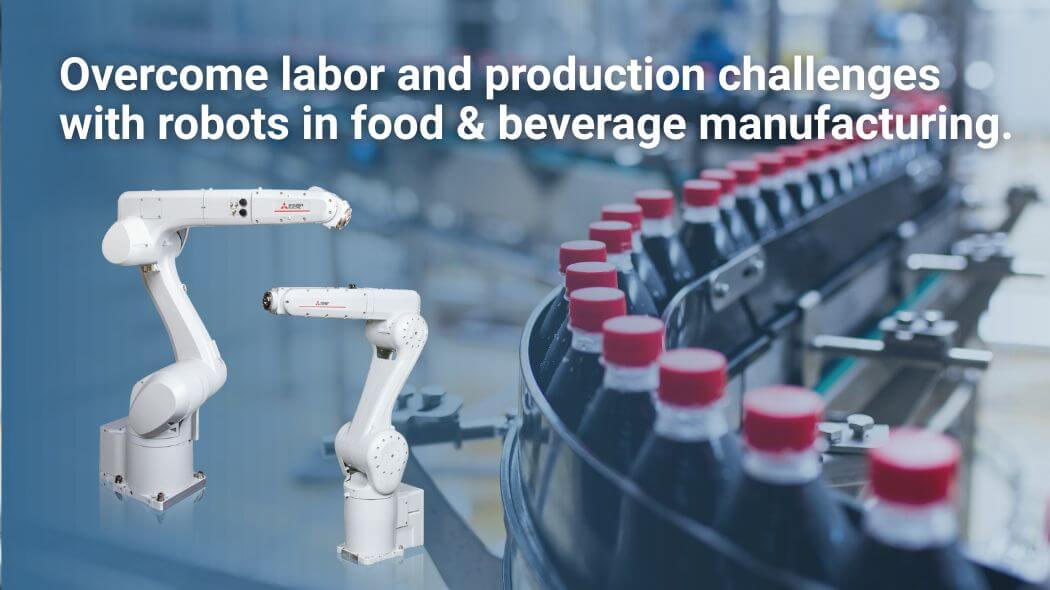
The food and beverage industry faces immense pressure to maintain low margins, handle high product variation, and meet regulatory demands. Under the pressure of this industry, automation is imperative for food and beverage manufacturers. The main challenges faced by food and beverage manufacturers, including labor shortages and the need to comply with a variety of regulations, must be addressed while maintaining expected production outputs. Let's look at how robotics and digital twinning can help food and beverage manufacturers overcome these challenges, and explore the solutions we offer at Mitsubishi Electric to make implementation easier.
Challenges Faced by Food and Beverage Manufacturers
Many challenges faced by food and beverage manufacturers can be mitigated with robotics and automation. These challenges include labor shortages, high turnover rates, skill gaps, and seasonal labor needs. These challenges persist as manufacturers face increased production demands, regulatory oversight, and the need to consistently produce high-quality goods. That's where automation and more intelligent control come in. Through bridging skill gaps, increasing production, and ensuring regulatory compliance with quality standards, robots are becoming a critical part of many manufacturing and production processes, and the food and beverage industry is no exception.
Digital Twinning and Simulation for Food and Beverage Lines
Digital twinning and simulation enable manufacturers to see what production lines would be like with the addition of robotics without the significant capital commitment. It helps visualize the line, test scenarios, and simulate what the change would look like in real time before implementing the robots into the manufacturing process.
Digital twins will ultimately reduce the risks associated with integrating robots into your manufacturing process by enabling you to visualize the changes and their benefits. Our Mitsubishi Electric MELSOFT RT Toolbox3 enables robot simulations to run in 3D CAD software.
RT Toolbox3 will allow you to:
- Check the environment before installing the robot
- Debug when robots are started up
- Monitor their state and faults during operations
Before you implement a capital-intensive robot into your lineup, use our software to ensure it's an effective and efficient decision for your business as a whole.
Industrial Robots vs Cobots: What's the Difference?
Both industrial robots and cobots are popular options for those looking to add automation to their manufacturing plant; however, it's crucial to understand the differences and capabilities of both. Many people think cobots are more cost-effective and efficient than they actually are, but ultimately, they are not the best option for many applications. Industrial robots are still needed for precise, high-speed applications.
Cobots: A Breakdown
Cobots might not be able to do everything an industrial robot can, but they are suitable for low-speed applications when human-adjacent tasks are involved. They're designed for low cycle rates and lighter payloads. Most cobots lack the precision or high-speed capabilities possible with industrial robots. Cobots typically have lower operating speeds, less reach, and fewer payload options. There is still the need for a safety risk assessment and safety equipment when cobots are deployed.
However, since cobots work safely alongside humans, there is still a need for these systems. At Mitsubishi Electric, we offer a cobot that is used for tasks in the food and beverage industry: MELFA ASSISTA. It's a cobot that can share a workspace with humans in areas where you want collaborative effort. It's smart and equipped to meet the needs of the food and beverage industry because it can be easily reprogrammed through a visual programming interface and can be relocated to other applications on your floor fairly quickly and easily.
Industrial Robot: A Breakdown
Industrial robots are essential for areas where a cobot won't suffice, such as high-speed environments, areas that require precise trajectory control, or when you need them to run for an entire production day without human intervention. They are most suitable for high-speed tasks, handling heavy payloads, and high-speed packaging lines with large volumes, as well as areas where hygiene is critical. An industrial robot can fully replace humans in such environments, which is why they are much more powerful, precise, and intelligent than cobots (which often require a human in the same workspace). We offer the MELFA FR Series, an industrial robot series designed for precise and high-speed applications commonly seen in the food and beverage industry. The MELFA FR Series contains both SCARA and 6-axis arms with a variety of reach and payload options.
Food and Beverage Specific Requirements
The food and beverage industry has specific requirements that must be met when implementing a robot into the production line. Because food is involved, hygienic food safety is of the utmost importance in food and beverage manufacturing. It requires frequent cleaning and washdowns, clean-in-place regimes, and sanitation standards, among other requirements. Food and beverage robotics must frequently integrate with vision and inspection systems to meet the quality and safety requirements of food products. The robots themselves often must be specifically designed for the food and beverage industry, featuring sealed motors, stainless steel covers, and easy-to-clean surfaces. We offer a variety of food-safe robots from Mitsubishi Electric, helping to streamline your manufacturing process while ensuring compliance with food and beverage requirements.
How to Decide Which Option is Best for Your Needs
When considering cobots and industrial robots, there is a place and a need for both, which will determine which option is best suited for your particular manufacturing needs.
The biggest deciding factors between a cobot and an industrial robot include:
- Speed and precision requirements
- Human-free or human-collaborative operation
- Payload requirements
It's essential to identify your needs to determine which option can efficiently handle what your manufacturing line requires. Once you've decided, utilize digital twinning and simulation to see firsthand how it will change and improve your food and beverage manufacturing process, and to better understand what that will look like after the robot installation.
Implementing Robotics in Food and Beverage Manufacturing
Industrial robots and cobots are both great options for the food and beverage industry, as they can streamline processes and increase efficiency in the production line. Cobots may be a suitable option for some scenarios, but for high-volume production, industrial robots are a better fit. At Mitsubishi Electric, we offer a range of solutions, including our industrial robot series, cobots, simulation software, and edge computing options. We are here to assist you with everything from line assessment and digital twin simulation to determining the right robot and implementing it into your manufacturing line for ease of integration.
Interested in increasing efficiency in your food and beverage manufacturing plant through robotics?


-
Inquiries
-
Select
& Quote -
Share
-
Partners