


Blogs
Robotic Innovations Transforming Food & Beverage Production


Summary: This blog explores how food & beverage factory robots help manufacturers overcome labor shortages, rising costs, food safety risks, and supply chain volatility through automation, AI vision, and collaborative robotics.
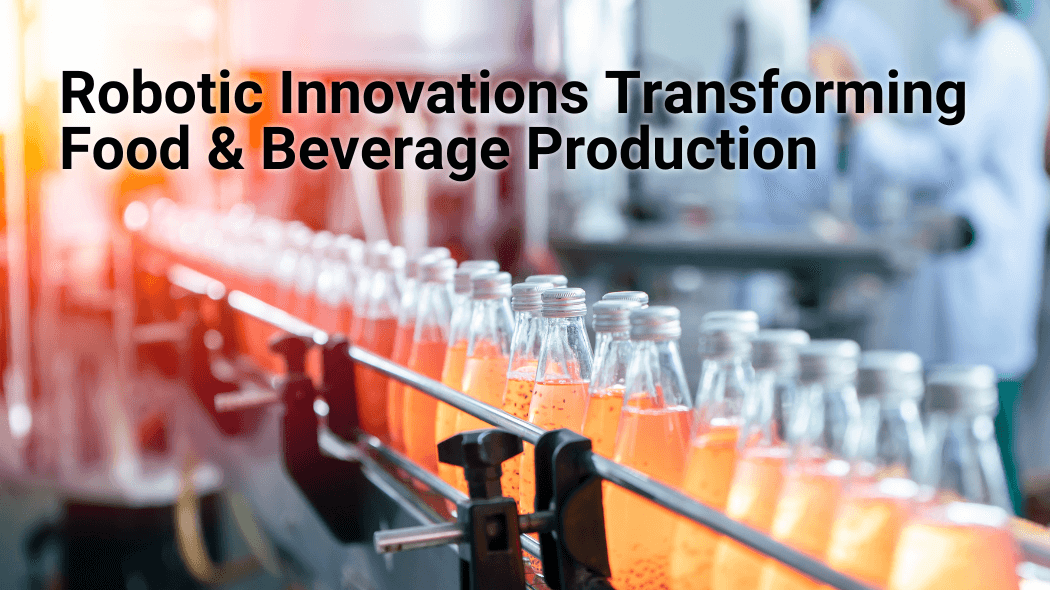
Business bankruptcies happen, but when it’s a favorite food and beverage, the bankruptcies are impossible to ignore. Consumer spending habits play a role in some bankruptcies, but many other factors also contribute.
Take the California cheesemaker, Rizo Lopez. Recalls from a decade-long listeria outbreak were tied to production facilities, leading to the company’s closure. Investigations found the bacteria in the manufacturing area where cheese was stored before packaging.
Since food-grade robots are easy to clean and sterilize, they’re useful in high-risk areas where contamination is a concern. Contaminants and foreign objects can be detected using innovative X-ray sensors and AI vision. Innovations in food & beverage factory robots significantly improve production rates, enhance safety, and increase accuracy.
Food & Beverage Production: What Are Your Biggest Challenges?
Consider your production plant. What are your biggest production challenges? Like many other food and beverage companies, you may struggle with the following:
Cybersecurity
Cyberattacks in the agriculture and food industries increased by more than 600% in 2020. Automation and AI are targets, yet they’re also essential to improving productivity and efficiency. This is why it’s important to choose a partner in food & beverage robots and automation that prioritizes security, such as applying the latest NIST cybersecurity guidelines.
Increasing Costs
Raw materials, energy consumption, and insurance costs are rising. Employers faced increases of up to 6% in 2025 and 7% in 2023 and 2024. Industrial robots lower energy costs, which can be a first step in saving money. Food & Beverage robots also increase production, efficiency, and safety while reducing waste and downtime.
Labor Shortages
About 80% of manufacturing experts named labor shortages as their greatest barrier to growth. As older workers near retirement and younger workers look toward other fields, it’s hard for some areas to find enough workers. Robots fill those gaps. They also work around the clock and don’t need time off for illness, holidays, or vacations.
Regulatory Compliance
Every year, states and the federal government build on existing laws to make the world safer. Food and beverage manufacturers must follow the FDA’s HACCP principles for food safety. An employee’s unintentional error could lead to the recall of entire batches of food and beverages.
Lawsuits take time to prepare and can be costly. Food & beverage factory robots reduce human involvement in production areas where contamination is a risk. With robots handling tasks in sterile environments, the threat of accidental cross-contamination is less of a concern.
Supply Chain Disruptions
The World Economic Forum and Kearney agree that persistent volatility is the future of the global supply chain. Given this volatility, there is no guarantee that materials will reach you in a timely manner. You need production lines that work efficiently and quickly. Robotics and automation deliver those goals.
Improve Speed and Accuracy with Automated Production
The MELFA FR Series shortens start-up times while increasing accuracy. Intelligent technology, such as force and vision sensors, simplifies the most challenging tasks in your food manufacturing process.
Another benefit is the collaboration this system offers. Edge computing analyzes data and works with your company’s IT systems to collaborate with the food & beverage factory robots. With added safety features, such as positioning and speed monitoring, production is faster without sacrificing accuracy. Your factory lines produce more without error.
Food and Beverage Factory Robots: Success Stories
Mitsubishi Electric is transforming the food and beverage world with automation, AI, and robots. Here are some of the advanced automation solutions featuring cobots and robots deliver the benefits your food and beverage company needs.
Haley Manufacturing
As a leader in produce packing equipment, Washington-based Haley Manufacturing came to us seeking automated solutions for bagging, handling, packing, and weighing produce. Because produce requires a gentle touch to prevent damage and bruising, precision was vital.
Working with Mitsubishi Electric Automation, Haley turned their vision for a robotic pad inserter into reality. Instead of having workers fit each foam pad or other material into the packaging, the 6-axis robot completes the task faster and with precision.
Goals for the pad inserter were to be cost-effective. To do this, the equipment had to:
- Be able to identify the box size and choose the correct pad size.
- Be able to hold multiple pad sizes and materials.
- Be compatible with integrated software that enables predictive maintenance to eliminate unexpected downtime.
- Have a pad dispenser capable of holding bulk pads of different sizes.
With the industry’s first-known robotic pad inserter in place, Haley Manufacturing could pack produce into different box sizes on a single line. No additional workers were needed to do the job faster, which helped ease the struggles to find workers.
Hella Electronics
While Hella Electronics is not in the food and beverage industry, the solution Hella needed applies to the industry. Hella designs automotive electronics and lights. The company needed a collaborative system to work well with human workers in factory automation. Safety and precision were important to keep the robotic arms from accidentally hitting a nearby worker.
Mitsubishi Electric ASSISTA industrial collaborative robots (cobots) share workspaces with their human partners. Workers don’t need robotic expertise thanks to the visual programming software. Simple buttons make operations straightforward. You can also configure them with additional components and peripherals, such as grippers, to tailor them to your factory’s needs.
IPSUMM
New Hampshire's IPSUMM helps its customers bring their manufacturing visions to life. The company's engineers developed a robot-driven automation solution for assembly, packaging, painting, picking, visual inspections, and more, using plug-and-play components to enable the company to grow as needed.
While IPSUMM had their IRIS system designed, they needed a partner who could turn their prototype into a final product. Mitsubishi Electric became that partner. A robotics expert traveled to IPSUMM to work closely with the team. The resulting robotic arm could quickly move from one manufacturing task to the next while being scalable to grow with a growing company.
The MELFA RV-2 six-axis robot is packed with next-gen features and comes in a variety of arm sizes and configurations. Environmental conditions don't affect it, making it suitable for use in a hot climate, such as a large-scale bakery, or in a plant where some perishables, like dairy products, require freezing temperatures.
Talk to Us About Your Company's Goals
We're happy to discuss your food and beverage company's needs. Fast, efficient, and cost-effective is vital in today's food and drink industry. Our innovative robots help you exceed your goals.
Whether you are bottling trending probiotic sodas and need robots that can work in cold temperatures to protect the survival of the probiotics during packaging or require high-tech automated packing to get different quantities of produce packed in boxes without causing bruising, Mitsubishi Electric can help. Reach out to us for a quote or to learn more about food & beverage factory robots.


-
Inquiries
-
Select
& Quote -
Share
-
Partners